Awesome last couple of posts! Makes me want to do a post about the stereo receiver I refurbed for my dad.
2 Likes
Nice! I have a few of these drives myself. The only real downside is the speed that they rip Wii or Gamecube games. I’m trying to write a script that will automatically rip the game as soon as the disc is inserted.
1 Like
Bandai Tamagotchi Gen 2 (1996) Repair:
I found out my girlfriend was looking for a Yellow 1996 Tamgotchi to relive some nostalgia and not being very successful in her search, so I contacted my friend in Japan who found this in his retro game store warehouse for me:


He let me know it was not working and said he would let me have it for free if I wanted it.
So I got it sent to me in a large parcel he was also helping me with which arrived this morning:

Indeed as expected it was not working and was missing a screw and the other screw was rounded:

So I had to get my drill and drill out the head of the screw very carefully as to not damage the case:

The LR44 1.5v coin cell batteries were of course dead and had corroded the battery contacts:

Using my fiberglass pen and IPA I clean up the battery contact terminals:

Using pliers I then also removed the remaining part of the stuck screw:
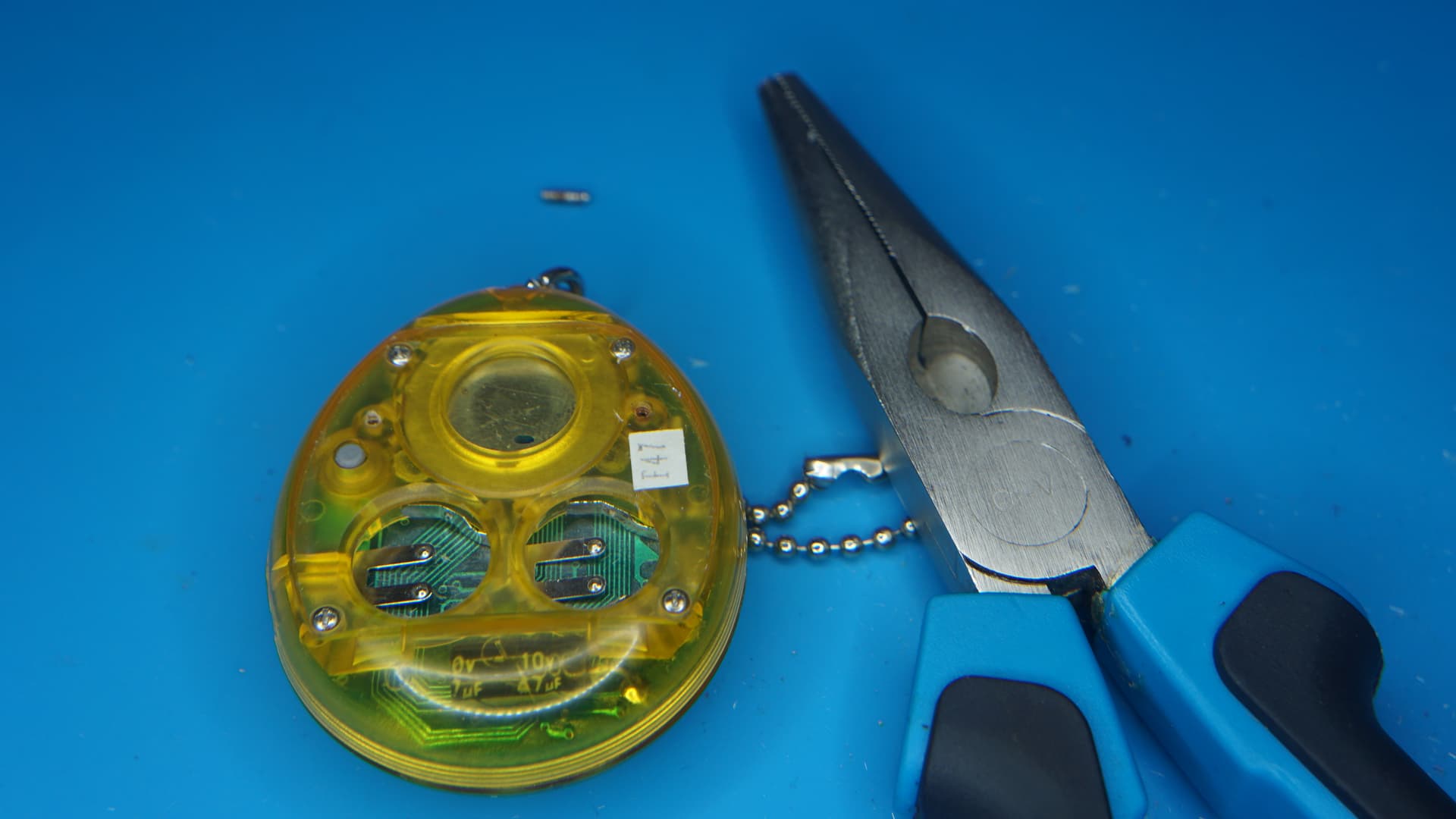
I then fully take it apart to properly clean it up:

The 47uf 10v capacitor ESR is a little high so that gets replaced:

I re-assemble it and you really need to make sure the screws are tight so the screen makes good contact with the PCB, but not so tight that you strip the thread (so be careful if you work on one):

Thankfully I keep a bunch of assorted screws around salvaged from various junk and find two perfect replacements for the battery cover:

Now for the moment of truth:

This will make my girlfriend super happy for Christmas and keep her occupied for quite some time.
And since it is Christmas: MERRY CHRISTMAS GUYS
Expect more repair logs to come in the new year! 
9 Likes
Hi I just needed help with my final fantasy 2 cartridge I was recently playing and the screen kept going black and then after turning it off and on again it glitch and wiped out my saved game I played for five hours not sure what the problem is just wondering if you could check it out thanks
I have a Sharp Twin Famicom which gives me error 22 when I try to load disc games so I assume the belt or head need to be fixed. The dealer I bought it from a few years ago said the belt was new so not sure what happened. Also would also like to get it RGB modded and general internal maintenance/clean up if needed. @Suteneko do you offer repair services or know a good source of where I could send it?
1 Like
I’m in the UK and don’t generally offer out repair services as snowed under with what I have at the moment to look at. Depends on your location I guess.
1 Like
Ok, I’m in the U.S. so shipping all the way to the U.K. wouldn’t be feasible for me anyways. I have a friend here who might be able to help me at least do the belt install.
1 Like
@Suteneko does awesome work. I also offer Mod/repair services here in the US.
2 Likes
Great sleuthing on this one!
@Danexmurder as he has already mentioned should be able to sort this for you.
Great guy and can be trusted. He has done a fair bit of mod work for people on these boards.
1 Like
Thanks for the reply! I would definitely be interested, have you worked with Famicom Twin units before? I also have a Dreamcast that has a dead CMOS battery that needs to be fixed and would also like to have it import modded too so would possibly be sending that as well (Famicom Twin is priority though). Please feel free to message me the details on your services.
1 Like
Shoot me a PM and we’ll hash it out. Cheers!
Taito F3 - Taito Power Goal to Cleopatra Fortune Conversion:
I bought a very cheap Taito Power Goal Game board with the intention of converting it to Cleopatra Fortune, a game that I am a big fan of but can not justify its cost.

Removing the Game PCB from the case I am left with this:

Looking at the Mame Taito F3 documentation I was able to determine that I needed to de-solder the Mask Rom at IC positions 8,12,38,43,45 & 47.
CLEOPATRA FORTUNE TAITO F3 CONVERSION:
IC08 - 27C160 (100ns) Cleoptr Mame ROM: e28-01.bin
IC12 - 27C160 (100ns) Cleoptr Mame ROM: e28-02.bin
IC17 - 27C4001 (100ns) Cleoptr Mame ROM: e28-07.bin
IC18 - 27C4001 (100ns) Cleoptr Mame ROM:e28-08.bin
IC19 - 27C4001 (100ns) Cleoptr Mame ROM: e28-09.bin
IC20 - 27C4001 (100ns) Cleoptr Mame ROM: e28-10.bin
IC32 - 27C010 (100ns) Cleoptr Mame ROM: e28-11.bin
IC33 - 27C010 (100ns) Cleoptr Mame ROM: e28-12.bin
IC38 - 27C160 (100ns) Cleoptr Mame ROM: e28-03.bin
IC43 - 27C160 (100ns) Cleoptr Mame ROM: e28-04.bin
IC45 - 27C160 (100ns) Cleoptr Mame ROM: e28-05.bin
IC47 - 27C160 (100ns) Cleoptr Mame ROM: e28-06.bin
These are carefully de-soldered one at a time:

Sockets are soldered into their place and since the CPU and SOUND PROGROM EPROM are already fitted in sockets these can be simply removed from their sockets:

Cleopatra Fortune requires a D17-15 PAL at position IC21 for ROM addressing . However Taito Power Goal uses the more common D17-14, so I have to program a GAL to D17-15. to replace it.
I then program all the required EPROM and insert them into the PCB:

You may notice I have not yet removed some remaining Taito Power Goal Mask ROM. You can just leave them in the PCB and it will not affect anything as they simply wont be addressed by the game.
In this state I test if Cleopatra Fortune runs correctly:

And a 1cc later I can confirm it certainly is.
To clean up the conversion I now also remove all the extra unnecessary Taito Power Goal Mask ROM from the positions I did not socket already:

I now create new labels for the Taito F3 Cartridge housing again making sure to note on them that this is a conversion:


These were printed on glossy sticker label paper at a local printer and I used a multi size corner rounder punch tool to give the corners a more professional look and applied them to the cartridge:

The original label and EPROM.Mask ROM are all safely stored away so in the future it will be possible to revert this back to its original state:

4 Likes
Awesome work as always! Super cool to see!
I always enjoy reading this thread, but it’s also way above my understanding and abilities!
My interpretation of the latest update:
Taito F3 - Taito Power Goal to Cleopatra Fortune Conversion:
- Purchase Power Goal
- Perform witchcraft
- Done!
I mean I get some of it, but program EPROM stuff is like, what now? I also love the printed label rounding, noting the conversion, and packaging the unused components showing the professionalism to each project. I find I’m frequently guilty of function over form so it’s inspiring to see people go all in.
3 Likes
It’s rather quite simple really.
An EPROM is just an “Erasable Programmable Read Only Memory” Chip which you can replace a Mask ROM with, which typically store (but not limited to) game data.
They have a window above the die on the chip which you can erase by shining UV light through it with an “EPROM Eraser”, which is just a fancy box with a UV light inside and a timer.

There are some caveats such has you need to match the following:
- Data Size (You can match the size exactly but any multiples of the original size is fine)
- Chip Footprint. (You need to match the physical size and number of Pins)
- Pin Compatible (All the pins need to match the Mask Rom Pin Out from schematics)
Once you have the required ERPOM and have erased it you can then write data back to it via a programmer. I use a Topall3000 as pictured below:

There are plenty of options though such as the cheaper TL866 and you could even use BBC Micro to do the programming if you add a certain module to it.
Connect the programmer up to a PC and run its software where you then select the EPROM type and vendor that you want to write data to:

The just load in the binary file and tell it to write the data.
Always best to verify data though as EPROM can fail and bits can get stuck.
6 Likes
This thread will be useful I have a ton deffective gaming equipment id like to repair or have someone repair for me.