This is a great point. When you think about how much knowledge is being written in a place like Discord, where most will never be able to search or see it, having RGB is a phenomenal boon. Thanks to @Peltz for everything.
5 Likes
P47 2, a game developed by Jaleco in the early 90s but never released is finally getting a release in March!
Pre-order are now up on Amazon.co.jp
2 Likes
This is why I vastly prefer forums.
Almost every time I’m looking into an obscure topic the best info is recorded on a forum somewhere by someone trying to figure out a problem, with other experienced people chiming in with more information.
5 Likes
RIP indeed. an absolute repository for so much technical info, and a group of folks that were very kind & helpful when i was finding my way through SCART RGB and how to get the best signal from a host of classic consoles, nevermind insight into lesser known hardware revisions/etc
we know the story of what happened with nintendoage (segaage too), i don’t know if i’d heard what brought down assembler?
also, just remembered: these were the folks that got their hands on a dreamcast dev kit, found the unrleased prototype for toejam & earl 3 (pre xbox), worked to make it playable & dumped it free for the community. i’m told that might not have been the only game they did that for, too - absolute champions
4 Likes
I was a mod at assemlergames for so many years. Basically from near the begining of the site.
Ultimately it seems that Kev who owned the forum has personal and possibly financial issues.
We never found out the true reason so we can only speculate. One thing that is true is thag without Assembler there would have been no Giest Force or Saturn 3D Sonic leak.
Also, Assembler was such a great place for sharing info as you mentioned.
3 Likes
Hoping someone might be able to help with this one. A few years ago I purchased a 10 pack of these to protect my small Genesis collection:
Recently I’ve been on a huge Genesis kick, bought a lot more games, and wanted to put them in the same protective case. But shipping is an insane $40 right now. 
I’ve spent a lot of time searching but can’t find any other vendor that sells a similar style cartridge protector box. There are a million options for the thin plastic “box” style protectors, (or even worse, bags) but I really want the hard plastic case. (Very similar to a GB/GBC one.)
Does anyone have another source for something like this?
Get your 16 bit farming on
1 Like
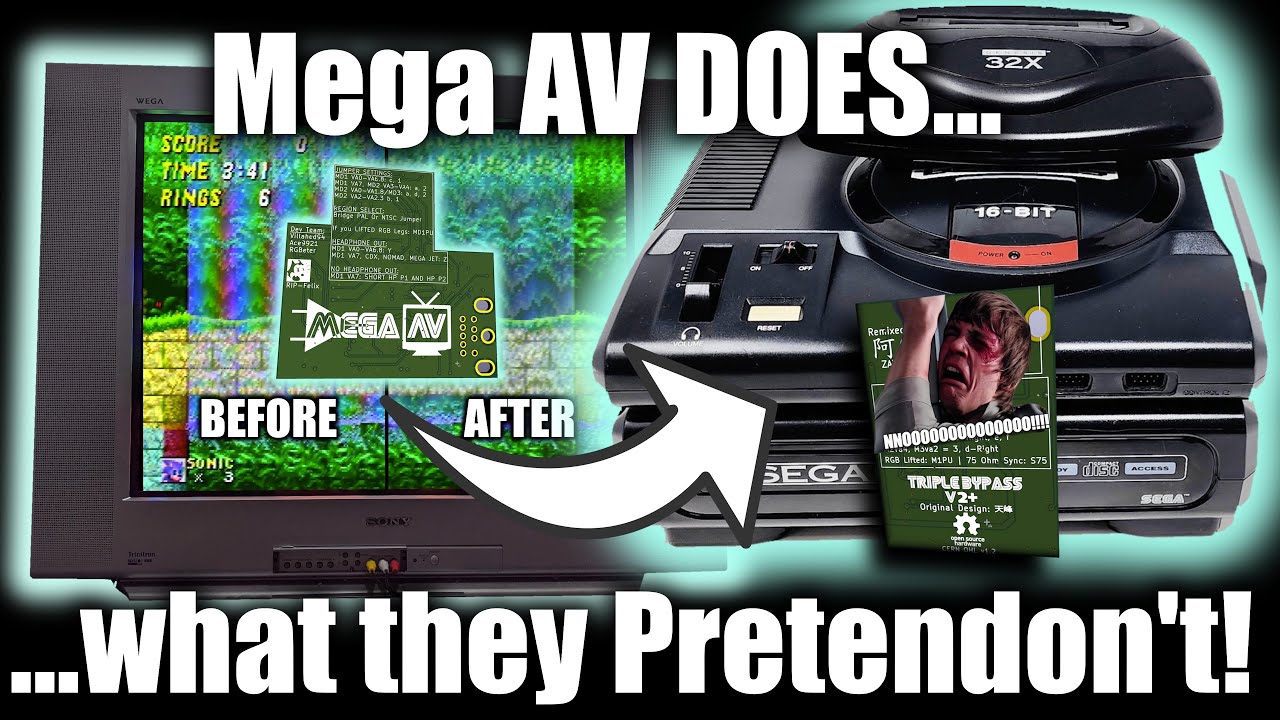
Finally good composite for every MD/Gen! Interesting to learn that the audio of the triple bypass board isn’t perfect.
1 Like
I’ve never understood caring about composite basically for one waterfall effect lol. I guess if you’re using a composite only old CRT.
2 Likes
I think the issue is when composite is shown off it’s always the sonic waterfall, gives the impression that it’s one effect but there’s lots of things that make use of composite (both transparency and creation of additional colours), I’m not even that familiar with the MD library but off the top of my head you want to check out:
Sonic 2 palm trees, Sonic 1 Marble Zone ‘pillar presses’, Sonic’s shield power-up, Streets of Rage 2’s light shafts, SoR2’s mist/fog, SoR’s 1,2 and 3’s portraits/illustrations, Comix Zone’s drop shadow and background dither patterns, Earthworm Jim’s multiple dither patterns, Shinobi 3’s Water, Waterfall and glass Lab floor, Lion King’s backgrounds and foreground elements (one of the most extensive use of ‘jail bar’ dithering I’ve seen in a MD game), McD Land’s water, Gunstar Heroes background elements (maybe the flame thrower fx too?), New 3D Golf Simulation HUD/UI, Vector Man’s background and foreground elements, SF2/SuperSF2’s portaits and floors (e.g. Zangief’s stage floor)
I’m way old enough to have been using composite on a large CRT back in the day and I can tell you that it still looked like crap compared to RGB. Sure, colours seemed more vibrant but there was colour bleed, composite artifacts and a massive drop in visual fidelity.
From experience it’s people from countries that didn’t have RGB as standard are the ones who harp on about the “advantages” of it. I can imagine this is due to nostalgia and who can blame them.
All can say is even back in the 80s and 90s everything was RGB or modded to be if possible.
1 Like
You’re not wrong, hence that mod looking for good composite.
This will always be dependent on the quality of your CRT though. I have a Sony Trinitron I still use via Composite for many systems because it’s just easier to do and it looks great.
to each their own (i ran an SNES on s-video for years, haven’t seen something for that format in a minute) but there’s absolutely systems i think look solid over composite: famicom/disk system, turbografx, etc
my least favorite ones ironically are the US genesis (model 1 as well, no idea if megadrives in other regions handle the signal better?) and the US NES. they’re both kinda washed out & the colors aren’t good for me, though ill admit a good CRT’s IQ may make this a variable for others. that said, while it is easier to get said signals, i’m with yakumo here: if my set was solid enough to make either genesis or NES look good enough with just one cable carrying all of the video signal, i’d be dying to see how it’d look with 3.
1 Like
This is true. Some CRTs really suck. I was lucky enough to have a very nice Toshiba and Sony Trinatron back in the day.
Surprisingly though, the best Composite image I ever saw was on a ITT Nokia flat screen from the early 90s or late 80s.
1 Like
Composite quality varies even within the same VA revision. I bought a VA4 PAL MegaDrive 2 earlier this year, didn’t need it but wanted to see the BH7236AF encoder in action and yep, no composite blending not even over RF*, minimal dot crawl, no ‘rainbowing’, turns out composite is not a monolithic set of qualities.
- *Somewhat wild that the evidence of seeing this encoder in action means my previous opinion of RF being a poor, smeary signal now requires me to acknowledge it can be done somewhat well
My reevaluation of composite was was sparked by the MISTER MD’s composite blend option and also working on the S-Video NUS-003 mod for the N64, also partially wanting to understand the people who like composite having used RGB ever since my Saturn came with a SCART cable. What I discovered is there’s a ton of nuance. My notes:
-PAL vs NTSC dot crawl: PAL tends to exhibit smaller dot crawl
- ‘Active’ and ‘Passive’ dot crawl - Forget where I read this so I might have them labelled wrong, Active dot crawl is when the screen/sprite moves only then will the dot crawl begin to ‘crawl’, think of PC Engine or Famicom. Passive dot crawl is regardless of screen/sprite movement, the image will exhibit dot crawl constantly, think of GameCube composite.
-Composite (as well as S-Video) open up two (or three if using an NTSC signal) options on a CRT that are not available to RGB users, Saturation and Sharpness (plus ‘Tint’ for NTSC). Subjectively speaking, these come in handy for certain systems or even particular games, for example, and for my tastes, I prefer tuning N64’s look to be more on the vibrant side than my RGB modded console so I use S-Video. Pushing saturation up also allows me to see the ‘illegal’ Famicom colours that you won’t get on the RGB mod. I like softening the image when playing Dreamcast’s JoJo bizarre adventure, the dark sprite outline ends up looking more organic and thus more reminiscent of the animation/manga so I use PAL S-Video (RGB for all other games). Tint lets me pick a blue or purple-ish sky in mario bros.
-Composite (and S-Video) has better CRT image centering vs RGB - self explanatory, there are some devices that can help in the case of screen shifting with RGB although they are somewhat flawed.
-Games mastered in NTSC colour space - Premier example being PC Engine, see the RGB mod giving the appearance of missing colours or exceedingly warm tones in some games, a trade-off has to be considered between stock composite with active dot-crawl or RGB clarity but ‘off’ colours. (Zaxour’s S-Video mod is the best option here imo)
-Composite (and I guess RF) blending appears to be a unique characteristic particular to that signal. NOT utilised by every game, console or dev team it must be noted.
-Some CRTs come with notch/comb filters, this can make consoles with bad dot crawl appear to have decent composite output. Similarly, how luma is handled depends on the CRT, I have Sony Trinitron that handles it better e.g. I don’t see a red fringe in SMB when playing Famicom on it but I do on my Panasonic set.
-PC Engine’s composite is often regarded as being excellent, I think there’s an interview with a SEGA dev who said they were jealous of the quality. Having looked at it myself it is very impressive, sharp, no colour bleed, generally low noise but suffers from ‘active’ dot crawl, imo the best composite I’ve seen is the N64’s, specifically the NTSC output (PAL is poor), nearly identical to S-Video output but what makes it special is the method used to disguise dot crawl, truly impressive.
-Recent discovery that I don’t think I’ve seen anyone talk about, NTSC GameCube (not tested PAL) has passive dot crawl, it’s sadly a step down from the N64’s but if you’re using the GBA player @240p res you get a dot crawl free picture. It has softer/organic quality vs the sharper S-Video output.
Having no nostalgia for composite and only having revisited fairly recently (a year or two after MISTER came out) I’m glad I looked into myself, common opinion had me believe there is only bad composite (yes, bad composite is a thing) and I’m kind of embarrassed by my younger self and my ‘RGB or bust’ attitude but now I know there are trade-offs with every signal. I’m not recommending to use composite 100% of the time on 100% of your consoles or even 100% of that consoles library, use what you want, but I will say that it’s not as cut and dry as some people have made it out to be.
6 Likes
What a fantastic write up!
Agreed with D.Lo, great writeup.
Personally, I go with composite for the two consoles I know of that are mastered in the NTSC color space (NES and TG16). Otherwise I use RGB or Component.
I like the “illegal” colors of those systems and want to keep them intact. Especially with NES which I grew up with. I don’t like “active” dot crawl, as you put it, but put up with it for those systems to have accurate colors.
“Softness” of composite doesn’t bother me though. Nor does the loss of dither blending when using RGB on systems like Genesis. The nature of a CRT, even an extremely sharp one like my PVM 20L5, means it’s still going to look more organic than playing these games on a fixed pixel display which is far too raw and unfiltered, even when digital filters are applied to blend the dithering or add scanlines.
There’s a natural look that happens on even the cleanest and sharpest RGB monitor by just rendering games at their native resolution without scaling that makes dithering still look good even with strong pixel separation. The fact that 20” CRTs are just much smaller than fixed pixel displays also helps with keeping things coherent and pleasant. On a 100” screen, perfect separation of pixels will ruin the illusion of dithering more than the same level of separation on a 20” display.
I’ve basically gotten to my end-game setup and stopped tinkering with settings. Whether a dithering effect is “ruined” by RGB or whether the dot crawl is present for Composite doesn’t really bother me anymore. If it’s on a CRT in decent enough condition, it’s all “good enough” for me to enjoy.
My obsession on tinkering with my retro gaming setup is over. It has been replaced with focusing more on my hifi/sound setup in my living room. There, I’m becoming very obsessed with comparing analogue vs digital, tubes vs solid state (and all the variations of those technologies) different digital filters of my DAC, different amps, preamps, phono stages, turntable cartridges, etc. It has become really fun to find vintage stereo hardware and see how it performs.
1 Like